Download COR® audit instrument
Download the new COR® audit instrument for Nova Scotia here.
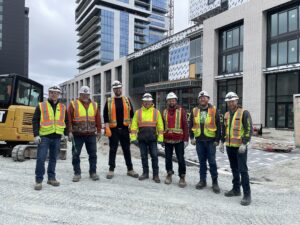
A healthy and safe work environment is a non-negotiable at Bird, including supporting employee mental well-being. The company pursues a “holistic approach” to employee health and wellbeing, and strives for an empathetic culture that considers the mental health and psychological safety of all employees. Bird was the inaugural winner of Construction Safety Nova Scotia’s Workplace Mental Health Award, presented at our Annual General Meeting this past April.
Bird’s mental health program was developed specifically to address a need within the company to address a gap that has likely existed for a long time, but has been significantly amplified through Covid-19, said Dan Andersson, HSE Director, Atlantic, at Bird. Managers receive Mental Health First Aid training so they are equipped with the tools to recognize and assist workers who may be facing challenges with their mental health. Through the company’s Workday learning module, there are numerous free courses on the topic of mental health available to employees. Bird employees and their families have access to an Employee and Family Assistance Program (EFAP).
In step with Merit Nova Scotia’s Workplace Wellness Program, Bird is facilitating site-based toolbox talks with a specialized theme for each month, such as mental health stigma, suicide prevention, depression and anxiety, respectful workplaces and emotional intelligence. Andersson says when they first started these toolbox talks, it would just last about 15 minutes, but now sometimes they last for an hour as people have really started to open up.
“Our intent is to talk about this stuff, be open, and let people know it’s ok to talk about these things,” he says. “We spend eight hours a day with people at work, but we have no idea what goes on in the other 16 hours in their life. Being able to create a safe space where people feel comfortable to talk about these things is important.”
Part of the Merit program provides workers with access to “wellness champions” within the company who are passionate about mental health and who assist with putting up posters and educational pieces around job sites.
New programs
Of course Bird focuses on physical safety too, and a new program has increased near miss reporting by 40 percent from 2022 to 2023. QR codes are placed on safety board and throughout a project site, so workers have easy access to scan it and digitally fill out a near miss form.
“It gets rid of the old way of having to go find a near miss card and fill it out and submit it. Workers can submit near misses when they are live and active in the field, and the project team will get an email notification right away,” said Andersson, adding corrective actions are then put in place after a discussion with the workers.
Yet another new initiative that is being piloted at the Richmond Yards project in Halifax is the “energy wheel field level hazard assessment,” a researched-based visual tool that helps workers identify hazards that they perhaps would have naturally overlooked.
“I think sometimes you get focused on the work you’re doing and don’t immediately see all the hazards,” says Andersson. “For example, say you’re working on a project site and doing something at ground level, you may not realize there are people working overhead on a balcony. The energy wheel goes through 10 different categories of hazards and then you see if you can spot any in your immediate work area.”
The focus on mental health, new OHS programs, and engaging workers in safety comes straight from the leadership team at Bird.
“It starts at the top with our District Manager being committed to safety,” says Andersson. “The first value we talk about at Bird is ‘We put safety first’, so that is ingrained in the company culture.”
As a construction employer, you’ll recognize at least one of these important construction safety organizations helping you to work safer.
- BC Construction Safety Alliance
- Alberta Construction Safety Association
- ASP Construction Association sectorielle paritaire
- Construction Safety Association of Manitoba
- Construction Safety Nova Scotia
- Heavy Construction Safety Association of Saskatchewan
- Infrastructure Heath & Safety Association
- Manitoba Heavy Construction Association
- New Brunswick Construction Safety Association
- Newfoundland & Labrador Construction Safety Association
- Northern Construction Safety Association
- Northern Safety Network Yukon
- Saskatchewan Construction Safety Association
But if you printed each of these names on trading cards and sealed them in a wax pack, the wrapper would read “CFCSA: The Canadian Federation of Construction Safety Associations.”
The name may not be familiar to everyone, but as a united umbrella organization, the CFCSA represents a formidable force. The CFCSA shepherds national programs such as the COR® accreditation standard, and the National Construction Safety Officer (NCSO®) and National Health and Safety Administrator (NHSA™) designation programs. In addition, the association promotes awareness of construction health and safety practices and programs, facilitates information sharing, and collaboratively produces workplace health and safety training, standards and information resources.
The CFCSA meets annually and the chairperson is typically the head of the construction safety association scheduled to host the next annual meeting. Standing committees meet throughout the year.
Sean Scott, immediate past chair of the CFCSA, notes that the organization takes on the difficult problems of harmonization of safety regulations across the country.
“Construction safety regulations are primarily issued at the provincial or territorial level, so it’s a challenge to get those jurisdictions to harmonize regulations,” says Scott. “As a national organization we look at the large picture and advocate for that type of harmonization, and help our members operating in different provinces to navigate the remaining differences.”
Mike McKenna, executive director of the BC Construction Safety Alliance, notes that the CFCSA has also endorsed a harmonized audit approach for COR® certification. Similarly, a memorandum of understanding between CFCSA members provides a simple path for companies who are COR® certified in their home jurisdiction to apply to have that certification recognized in any other jurisdiction, at no cost. This allows companies to bid on any project requiring COR® certification in a jurisdiction in which they don’t have a permanent base of operations.
“The CFCSA exists to make safety simpler for all of its members,” he says. “There’s a real benefit for employers who work across jurisdictions.”
Jackie Manuel, chief executive officer of the Newfoundland & Labrador Construction Safety Association, says that information sharing between associations provides the greatest benefit to local members.
“The early sharing of COVID-19 resources by larger construction safety associations who had in-house epidemiologists benefitted more than just construction companies here,” she says. “Our website became the go-to source for working during a pandemic for many employers in the province.”
When road contractors were asked to perform night work on a provincial highway project for the first time in the province’s history, Manuel quickly sent out a query to CFCSA members across Canada who already had experience with the practice.
“Safe work practices and procedures related to night work on a highway already existed,” she says. “Our contractors were quickly able to adapt them to their specific circumstances.”
Roy Silliker, CEO of the New Brunswick Construction Safety Association and current CFCSA chair, says that sharing of information resources has helped his organization to stretch its budget.
“One of the biggest benefits is the ability to get materials, programs, and toolbox talks that have been developed in other jurisdictions free of charge,” he says. “That allows associations such as ours to get resources that we may not be able to develop due to lack of funding. Any time we’re looking at doing something new or different we survey our sister associations in the CFCSA to see if they’ve tried it, done it or have materials for us to work with.”
CFCSA member organizations understand that — even if safety regulations aren’t perfectly aligned across all jurisdictions — a fall is a fall wherever it occurs.
“But when CFCSA members talk to each other and share best practices, they tend to become the accepted regulatory standard in each jurisdiction in which they operate,” Scott says. “That helps to build regulatory harmonization from the bottom up.”
For more information, visit www.cfcsa.ca.

Trane Canada has won Construction Safety Nova Scotia’s Chair’s Award for Safety Excellence – Standard Business two years in a row. They are going on just over four years with no recorded incidents. According to Donnie Clarke, area service manager, one of the reasons for the company’s success is because safety at the HVAC company is not just done because workers are told to do it, but it has truly become embedded in the company culture.
“When your workers are working safe from a second nature standpoint, you’ve hit that gate where it’s now in the culture versus, ‘I have to do this because I have to check the box,’” he said.
Clarke accepted the award at the CSNS 2023 Annual General Meeting in April.
Like all good safety cultures, a commitment to safety comes from the top at Trane. Safety is supported at the highest levels and the senior leadership team makes sure workers have whatever they need to work safely. Trane supplies all the necessary PPE for its workforce.
The pre-job hazard assessment was recently embedded into the company’s Salesforce software so when technicians arrive at a job, they must complete the hazard assessment first.
“The beauty of this is it lets the team stop and think, ‘Ok, this is the hazard I am going to face today at the site.’ It lets them stop and take a look around, and they know they have done their due diligence, they can work safely, and they can proceed,” said Clarke.
All field leaders meet with the safety team across Canada on a monthly basis to review anything and everything safety related. For example, there might be some new PPE coming, near misses to discuss, or a new safety initiative being launched.
“We go away from that meeting and cascade that information down to our people,” said Clarke. “that national aspect of everybody doing the same thing from a safety perspective helps build consistency and uniformity.”
Trane is COR® certified in all three Atlantic provinces where it operates — New Brunswick, Nova Scotia, and Newfoundland and Labrador —which is important because it further solidifies that uniformity piece, Clarke explains.
“That keeps our safety program robust. We have guidelines that we work towards and abide by in all three provinces, and gives a point of reference for our technicians,” he said. “It’s the industry standard that we are holding ourselves to.”
Trane has been COR® certified consistently since 2003.
Mental health is a current focus at Trane, and the company recently extended its employee assistance program (EAP) to all unionized technicians.
“I tout that with our technicians and I give them that phone number. By nature, the trade, they are not ones to talk about their feelings, but a couple of times I have said, ‘Here call this number, talk to somebody and get some help,’” said Clarke. “Having access to that makes a difference.”
The following are the new questions and their respective sections for the new harmonized COR® standard.
2. 5 Are design and layout of the work area, ergonomics, machinery, and processes considered in the assessments?
2.7 Are the personnel competent to participate in the hazard assessment process?
5.1 Does the policy, procedure, or guideline include responsibilities for setting, implementing, and complying with company rules.
5.2 Are both company and project (work location) specific rules available?
8.1 Is there a method for the selection of safety and health training of employees?
8.2 Is there a method for the evaluation and monitoring of the knowledge, competency, and effectiveness of safety and health training of employees?
9.4 Are specific methods, forms, or checklists used to identify deficiencies for pre-use inspections?
12.1 Are approved and current versions of applicable documents readily available at the point of use?
12.4 Are leading and lagging performance indicators measured?
14 Procurement and Contractor Management
The organization shall establish, implement, monitor, and maintain a documented policy statement, procedure(s), and/or guideline(s) for procured products and services, including contractor management/outsourcing.
14.1 Does the company have criteria for the selection, evaluation, and monitoring of contractors and service providers?
14.2 Does the evaluation, selection, and monitoring include the ability and competency of the contractor to identify, communicate, and control hazards that may impact their own workers, your workers, as well as any other person?
14.3 Has the criteria for the selection, evaluation, and monitoring of contractors and service providers been followed?
14.4 Is there a system in place to coordinate safety and health requirements, roles, and responsibilities when multiple contractors/employers are working under your control?
14.5 Does the company have criteria for the selection, evaluation, and procurement of products that have the potential to create a hazard?
14.6 Has the criteria for the selection, evaluation, and procurement of products been followed?
Return to Work
15.9 Does a Return-to-Work policy exist?
15.10 Is there a Return-to-Work program in place?
15.11 Are the roles and responsibilities defined in the Return-to-Work program?
15.12 Is company specific Return-to-Work training conducted?
15.13 Is the Return-to-Work program evaluated for effectiveness?
Mental Health
15.14 Does the use initiatives or programs to support or educate workers in mental health and psychosocial hazards?
Q. Who is affected by these changes?
A. All COR® certified companies who all in the following classifications: Small Business, Intermediate Business, Standard Business, as well as any companies applying for COR® that fall within those categories.
Q. I’m an owner/operator. Do I need to do anything differently?
A. No. Nothing is different for owner/operators. You will stay on the same audit tool and process that you are currently using.
Q. What questions are new?
A. Click here for the complete list of new questions organized by section.
Q. What evidence is required to satisfy the new requirements?
A. The following evidence is required:
- Are design and layout of the work area, ergonomics, machinery, and processes considered in the assessments? (Hazard assessments which include an assessment of design and layout of work areas, ergonomics, machinery and processes.)
- Is there a method for the selection of safety and health training of employees? (Policy/procedure/guideline which includes a method for selecting training of employees.)
- Have the emergency procedures and response plans been reviewed, and revised as appropriate, at least annually? (Records showing that the company’s emergency response directives/plans have been reviewed annually. The records must indicate the results of the review and what corrective actions were taken (or reasons for no action being taken) to correct identified deficiencies.)
- Is there a system in place to coordinate safety and health requirements, roles, and responsibilities when multiple contractors/employers are working under your control? (Project plans; completed hazard assessments, inspections, site safety orientations, toolbox/safety/start-up meeting minutes, utility clearances, permits, SDSs, incident investigation reports, etc. )
- Does the company have criteria for the selection, evaluation, and procurement of products that have the potential to create a hazard? (Hazard assessments/analysis for the products which may be purchased.)
Q. Is it really difficult to meet the new standard requirements?
A. Evidence required to meet the Harmonized COR® Standard (2020) remains largely unchanged. Many companies have already developed and implemented the policies, practices and procedures required by the new COR® Standard.
Q. Do I need to re-do any of the COR® training that I have already completed?
A. No, if you already have completed the COR® training prior to the new standard coming out you will not have to re-do any of the training. For anyone that requires the COR® training after the new standard is released, they will need to take the new updated version of the COR® Evaluation course, which will be virtual instructor-lead training.
Q. When do I have to make the change over to this new standard?
A. You will have the option of a one-time choice in 2023 of using old audit tool or the new audit tool. OHS Advisors will contact you in advance of your 2023 audit to discuss options and help you prepare. Starting Jan. 1, 2024, all audits will be required to use the new COR® standard and audit tool. CSNS is here to support you in this transition and ensure you feel well prepared for the changes.
Q. What is the format of the new audit tool?
A. It will be available in multiple formats including traditional paper booklet, fillable pdf and our new digital e-audit instrument provided by AuditSoft.
Q. Can you tell me more about the digital audit tool?
A. CSNS is pleased to partner with AuditSoft to offer our members a digital option for completing their internal COR® audits. As of Sept. 1, 2023, all CSNS OHS Advisors will be using AuditSoft to conduct all external COR® audits, and members will be able to select the AuditSoft tool for their internal audits, if they so choose. If you are interested in using AuditSoft for your next audit, please contact CSNS at 1-800-971-3888 or cor@constructionsafetyns.ca. (Please note that both a paper-based and fillable pdf version will still be available to our members.)
Benefits of AuditSoft digital COR® audit tool*:
- No more paper: Say goodbye to paper forms & spreadsheets. With AuditSoft the whole audit process and workflow is digital. Evidence is gathered, assessed and findings documented all in one single easy to use application.
- Support at your fingertips: Each step in the audit is supported with clear and easy to follow guidelines, instruction, and auditor tips. No more guessing of what to do or look for. Even example interview questions are provided.
- Simple uploading of evidence: Evidence of supporting documentation, pictures to capture observations and proof of implementation and interviews can be uploaded and capture straight into the application.
- Automated calculations: No more manual tallying of interview results, scoring and calculating averages or data re-entry. All calculations are automated to save you time and remove potential errors.
- No more wasted report writing time: Once you have uploaded your evidence, completed your assessment, and documented your findings a professionally indexed and formatted audit report is generated immediately with a click of a button. This includes links to supporting documents referenced within the report.
- Continuous improvement: Once you have completed the audit all corrective actions and suggestions for improvements identified can be exported into a Corrective Action Report/Plan with a simple click of a button. This will drive continuous improvement, mitigate identified risks; and close the loop on the audit.
- Electronic submission & tracking: Submit your audit electronically, track your auditing progress and get notifications on missed sections. No more emailing back and forth or calls required.
- Access to your own COR® ScoreCard: Once your COR® Audit is approved by your association, you have access to AuditXchange which allows you to assess your performance against your peers, track year-on-year improvement, identify strengths and opportunities for improvement, use generated graphs in appropriate OHS sustainability reporting and share with relevant stakeholders to promote transparency of your OHS performance.
*Source: AuditSoft
Q. Will there be changes needed to my safety manual?
A. No major changes will be required to the structure and content of your safety program, but you will need to add and revise some elements to match the new standard’s requirements.
Q. How does this impact my internal audits?
A. Your internal auditor will need to have the required knowledge and skill to complete the new COR® Evaluation instrument. By the end of the summer, a new version of the course will be available should they wish to take it. Please note the overall process, mailout schedule, sending your completed forms back in to us will all remain the same — the only difference is the audit instrument itself but the process is the same.
Q. Is my COR® going to be in jeopardy if I don’t meet all the new requirements?
A. CSNS wants you to succeed in this transition. Our OHS Advisors and Administrators will help you understand the new requirements and what you need to do to meet them. If corrective actions result from your audit, we will work with you to implement the required changes within reasonable timelines so that your COR® standing is not affected.
Q. Can I just stick with the old standard instead?
A. For companies that expire prior to Dec. 31, 2023 you can use the old audit tool to complete your audit. Starting Jan. 1, 2024, all audits are required to use the new COR® standard and audit tool. CSNS is here to support you in this transition and ensure you are prepared for the changes.
Q. I don’t understand the changes and I need help revising my safety manual to meet the new standard, can CSNS help with that?
A. Yes, we have OHS Advisors and administrators on staff to help support your company through the transition process and be set up for success.
Q. How has the scoring method changed?
A. See below methods for scoring:
- All boxes under the techniques D (documentation), O (observation), and I (interview) MUST include a (√) or (x).
- Ensure ALL questions that have been confirmed with a (√) under the documentation technique have a supporting document immediately following the audit instrument section page.
- Write the audit question number directly onto the supporting document that, at a glance, clearly identifies where the intent of the documentation question has been met.
- Refer to the audit instrument guidelines for clarification on how to interpret each question and award points.
- Where a question is worth four (4) or more points, consult the guidelines on how points should be allocated. Where no specific instructions are given, positive response (√) equals full points, negative response (x) equals zero (0) points.
Q. What terminology has changed?
A. See below for a listing of definitions outlined for the new COR® standard (Note: the new COR® audit tool contains a glossary of terms for reference):
- Comprehensive Hazard Assessment is now referred to as Formal Hazard Assessment.
- New Employee: means an employee who is (a) new to a position or place of employment, (b) returning to a position or place of employment in which the hazards have changed during the employee’s absence, (c) under 25 years of age and returning to a position or place of employment after an absence of more than six months, or (d) affected by a change in the hazards of a position or place of employment.
- Leading Indicators: allow you to take preventive action to address that failure or hazard before it turns into an incident. Examples: The root causes of near misses, the percentage of inspections or behavior-based safety observations completed at a location, and training attendance and pass rates.
- Lagging Indicators: can alert you to a failure in an area of your safety and health program or to the existence of a hazard, leading indicators. Examples: injury frequency and severity, lost workdays, incidents and near misses, and. workers’ compensation costs.
- Return to Work: The audit must verify that the employer has a defined return-to-work policy that is right for the size, industry, and location of the business.

When Iron Maple Constructors was formed in May 2020, the ownership group made it clear right out of the gate that safety was of the utmost importance.
“Their belief is that production does not take precedence over safety,” said Earl Affleck, safety manager at the Dartmouth, NS-based general contractor. “If you need something, they get it for you. The safety culture has been passed down from the top.”
The company has a training matrix for site management and supervisors that includes a variety of courses, including WHMIS, basic first aid, leadership for safety excellence, accident and incident investigation, principles of loss control, hazard identification and control, JOHSC member/representative, fall protection and mobile elevated work platform/telehandler training. The majority of the courses except for mobile elevated work platform are taken at Construction Safety Nova Scotia. (Sneak peek: A mobile elevated work platform training course is set to launch later in 2023!)
“Our belief is if they don’t have that training, it’s hard to see whether someone is doing it right,” said Affleck.
Tilt-up work
One of the biggest hazard Iron Maple faces is likely the tilt-up work. The company, which has 140 employees, has a separate safety manual for this work, and it conducts a safety standdown to review the procedures with staff and the crane operator every time this work is conducted. The field-level hazard assessments are a valuable asset because if anything changes, it allows the workers to discuss it and make sure they feel prepared.
“It’s a high risk, and we need to make sure everyone understands their role because these panels could be 20 tons, and if something happens, it could be catastrophic,” said Affleck.
In addition to ensuring the work area is properly marked, workers are trained on proper ergonomics to ensure they are not bending or twisting, and they often conduct stretches before the work begins.
Involving staff
Affleck has about 50 topics for toolbox talks on the “resources” page of Site Docs that supervisors can pull from, and they are expected to choose topics relevant to the work or conditions at hand — heat stress in August, for example. They often give Affleck feedback if there is a new topic they would like to have available.
Affleck also makes sure to involve staff when developing safe work plans. He writes a draft then sends it around to workers who make their comments and suggestions, which Affleck incorporates into the final versions.
“The workers tell me what they want in it,” said Affleck. “They are very involved and they tell me step by step how they are doing it. We really can’t do it without their involvement.”
Recently, Iron Maple changed the name of its near miss program to “good catch, near miss” to encourage workers to report good catches — and it worked! The number of reports received has increased now that workers have switched their mindset.
“When it’s a good catch, it’s not a negative thing. A lot of people think with near misses that something did happen, but we try to catch it before it does,” said Affleck.
Young workers
Iron Maple is very committed to young worker safety and has many employees under the age of 30 in roles ranging from project coordinators to carpenters. The company believes in growing talent from within.
“Many of our superintendents started out as carpenters on the job site we believe in providing the atmosphere and training to allow our entry level employees to grow,” said Affleck. “They are the future; they will be the leaders of tomorrow.”
Iron Maple is the winner of the CSNS 2023 Young Worker Safety Award. Apprentices and new hires undergo a wide range of comprehensive training and new employees are placed with a more experienced mentor in the trades.
COR® certification
Iron Maple is COR® certified, which is important to the company because it is a nationally recognized standard. Iron Maple operates in Nova Scotia and New Brunswick, so having one consistent standard makes it much easier.
“COR® sets the standard for our clients. Not all clients require it, but the majority do,” said Affleck. “When people see that you are COR® certified they realize that you are committed to safety.”
Return to work
At CSNS, we are working with industry, the WCB, and other stakeholders to find ways to improve the return to work system for Nova Scotia construction workers and employers. This topic is near and dear to Affleck’s heart as he was an injured worker himself nearly 30 years ago before he got into the safety profession.
“Lumber fell on top of me and I was off work for six months. I had surgery on his back and leg. I am lucky to be here to tell you the truth,” Affleck said. “I know the value of getting people back to work safely.”
One of the hardest things about being off work due to an injury is you don’t feel part of the team anymore, he said, you lose that social connecting with your colleagues and it’s important to try and get your life back to normal as soon as possible — but safely of course.
At the company’s New Brunswick site, an individual has been off work due to an injury but after six weeks, they were able to return slowly, starting with just three days per week for four hours each day. Everything is done in consultation with their occupational therapist and their supervisor is very accommodating — whenever they need a break, they take it. Even though the worker was only off for three weeks, they were given a complete re-orientation of the site when they came back, and they walked through the work with their supervisor to determine what they could and could not do.
“In the old days, you came back to work or you didn’t get back. But now with early return to work, it allows someone to know I don’t need to work the full eight hours per day to go back,” Affleck said. “The key is to gradually get people back in a safe manner.”

May 15, 2023
Construction Safety Coalition — made up of 14 industry partners — coming together to address worker safety at heights
DARTMOUTH, NS — Every year, construction workers die on the job or are severely injured as a result of improper fall protection when working at heights across Nova Scotia. These injuries occur in all types of workplaces, including on residential homes when completing work such as re-shingling or building an addition. But most homeowners are unaware they could be legally and financially liable should an injury or fatality occur when a contractor is working on their home.
“When you are having work done on your home, the obligation of the homeowner under the OHS Act is the same as any other major construction site owner — but most homeowners are completely unaware of this,” said MJ MacDonald, CEO of Construction Safety Nova Scotia. “This means if an incident occurs, you could be held liable for medical bills, lost wages, or damages.”
To address this issue, a total of 14 organizations making up the Construction Safety Coalition have come together to launch a new fall protection awareness campaign funded through the Occupational Health and Safety Education Trust Fund. The campaign launches today across multiple channels and mediums, and targets homeowners across the province. It encourages them to ask for “TMI” when hiring a contractor:
T- Trained: Do they have safety training certificates for a Fall Protection course? Make sure they are not expired.
M- Managing safety: Do they have a safety policy or safety management plan in place? Do they regularly inspect harnesses to make sure they are in working order? Is safety something they take seriously?
I-Insured: Do they have Workers’ Compensation Board insurance? Ask for a clearance letter.
“In this case, TMI is a good thing! Homeowners should not shy away from asking for this information,” said Crystal Ingram, executive officer of the Canadian Home Builders’ Association – Nova Scotia, which is a partner on the campaign. “Good contractors worth hiring will be happy to show you these documents and proud about the safety protocols they have in place.”
“Safety in the roofing industry is not talked about enough in Nova Scotia. It seems that efficiency is king in our world when, in reality, we should be more focused on sending every worker home to their families at the end of the day. We prefer to train our workers to be efficient with the proper fall protection gear so everyone has the peace of mind needed to be working in dangerous situations,” said Andrew Solomon, owner of Rydel Halifax. “As a homeowner, I would strongly urge everyone to put their contractors through a proper vetting process to identify whether or not safety is a priority within their company. Fall arrest systems save lives everyday; I believe everyone working at heights should be properly certified to use this system.”
Resources and legislation pertaining to homeowners can be found at HireTMI.ca.
Nova Scotians can call 1-800-9Labour if they have questions about fall safety, or to report concerns about unsafe work.
ABOUT CONSTRUCTION SAFETY NOVA SCOTIA
Construction Safety Nova Scotia (CSNS) is an industry funded not-for-profit association focused on improving occupational health and safety in the construction sector. CSNS is a highly regarded leader in OHS services with over 300,000 students trained in health and safety and over 1,150 firms attaining the association’s Certificate of Recognition (COR®) safety certification. The board of directors, OHS advisors, and CSNS staff work towards a safer construction industry by engaging with its membership to reduce injuries and improve safety culture. The association is passionate about saving lives and reducing injuries through industry-tailored instruction and advice. https://csns.rpdev7.com/
ABOUT THE OHS DIVISION OF THE GOVERNMENT OF NOVA SCOTIA
Workplace safety is our number one priority. We will work with Nova Scotians so that everyone understands the province’s occupational health and safety rules. We use our Pathways to Compliance (PDF) to help ensure workplaces are compliant. We encourage Nova Scotians to work with us to build a strong culture of Health and Safety. Safety is everyone’s responsibility. Work safe, Home safe, Everyday.

May 25, 2023
Cape Breton OHS advisor will be available for training, mentorship, and help with COR® certification
SYDNEY, NS — Construction Safety Nova Scotia (CSNS) has opened a new office at the firehall at 850 Grand Lake Road in Sydney to meet the needs of construction employers across Cape Breton.
“We are seeing a flurry of construction activity across Cape Breton and we knew we needed to do a better job at supporting our members in this area. Now, we are well positioned to assist Cape Breton employers with training, certification, and consulting on all aspects of their safety program with this new office and a dedicated OHS advisor,” said MJ MacDonald, CEO of Construction Safety Nova Scotia.
A dedicated OHS Advisor will be posted in region and will be available for private training courses at an employer’s site. Additionally, the following courses are upcoming at the 850 Grand Lake Road location, with more being added shortly:
- Fall Protection Basic- June 7th, 2023
- Basic First Aid June 8th, 2023
- Confined Space Generic June 13th, 2023
- JOHSC June 27th, 2023
Companies can register their workers here: https://csns.rpdev7.com/course-registration/ or by calling 1-800-971-3888.
Members of Construction Safety Nova Scotia are any firms registered with the Workers’ Compensation Board of Nova Scotia under the construction industry classification codes 4011-4499 & 3551. They receive most training courses at a 60 percent discount. Non-industry employers can also receive training from CSNS — including the popular JOHS Committee/Rep course — at an additional cost.
ABOUT CONSTRUCTION SAFETY NOVA SCOTIA
Construction Safety Nova Scotia (CSNS) is an industry funded not-for-profit association focused on improving occupational health and safety in the construction sector. CSNS is a highly regarded leader in OHS services with over 300,000 students trained in health and safety and over 1,150 firms attaining the association’s Certificate of Recognition (COR®) safety certification. The board of directors, OHS advisors, and CSNS staff work towards a safer construction industry by engaging with its membership to reduce injuries and improve safety culture. The association is passionate about saving lives and reducing injuries through industry-tailored instruction and advice. https://csns.rpdev7.com/.

Jan. 3, 2023
By MJ MacDonald
Mental health is rightly a hot topic these days, but it is of a particular concern in the construction industry. According to the Centers for Disease Control and Prevention, the suicide rate for male construction workers is over four times higher than the national suicide average.
In Nova Scotia, 142 people died by suicide in 2021, and 107 were men. This figure is the highest on record since data was collected on this metric in 2008. While we don’t yet have an industry breakdown in Nova Scotia, it is likely safe to assume some were construction workers.
This presents a significant opportunity for business leaders in the HRM. There are 18,000 construction workers in the Halifax area and as a leader, you have a platform to help support better mental wellness and to shape their mental health both on and off the job.
Start talking
The first piece of advice is to start talking to your team members. Ask them how they are doing. Listen. Offer solutions that you as the employer can provide and be sure to have some external supports on hand as well. Some examples include the Employee and Family Assistance Program, extended health benefits for psychologists, a flexible work schedule, and lists of community and suicide prevention resources.
Mitigate job stress
There are many deadlines to meet in the construction industry and it can be a high-stress environment. To offset this, foster a culture of support and have programs in place that can make work fun, such as contests or friendly competition. Set realistic expectations and adapt your leadership style to meet individual employee needs.
Also, make sure to recognize and provide positive feedback. Take the time to ensure your team understands the bigger picture — the work they are doing matters. A simple thank you for a job well done means a lot.
Lead by example
My mother was very ill and passed away in April, during the COVID-19 pandemic. I shared this news at work, and it felt good not to try and cover up and pretend everything was fine. I was very grateful for the support and empathy I received from my teammates; it made a tough time much easier and it helped my team know what was going on with me.
We have an opportunity to open up about our own mental health. As leaders, everything we do is being noted by your workforce. If they see you okay with talking about mental health, they are much more likely to do the same.
Be sure to take care of your own mental health too. Be a role model for rest, setting realistic deadlines, and good self-care. We all need to stay emotionally heathy to be a successful leader.
Ensure a safe working environment
Mental health is tied to safety on the job. If you sustain an injury at work, it affects every aspect of your life and can also impact your mental health. As leaders, we must ensure a safe work environment and that all workers are following safety protocols. We know from our legislation that safety at work is the employers’ responsibility. Establish and support a Joint Occupational Health and Safety Committee. Review work areas, identify hazards, and work collaboratively to mitigate them. Collect and review safety data. Use it to formulate plans for prevention and implement these. We recommend that psychological safety and workplace culture be a component of a good safety program.
Get trained
At Construction Safety Nova Scotia, we heard from our members that they want more help supporting the mental health of their workforce. In our most recent member survey, 40% of respondents said they were “very interested” in attending a Mental Health First Aid training course. We listened and are now offering this course in our Dartmouth training facility. You can sign up at constructionsafetyns.ca/course-registration.
I took this course, and I am now certified in Mental Health First Aid. As a leader, I am much more prepared to deal with a mental health crisis, should one arise at my organization. I strongly encourage you to consider attending — you might just save a life.
Construction Safety Nova Scotia is a non-profit that offers training, safety and mental health resources, and Certificate of Recognition (COR®) certification to the construction sector across the province.
This article originally appeared in the December 2022 issue of Business Voice magazine, published by the Halifax Chamber of Commerce.